What Are the Best PVC Trunking for Cables?
- Written by
- Jason
- Published
- Reading time
- 11 min read
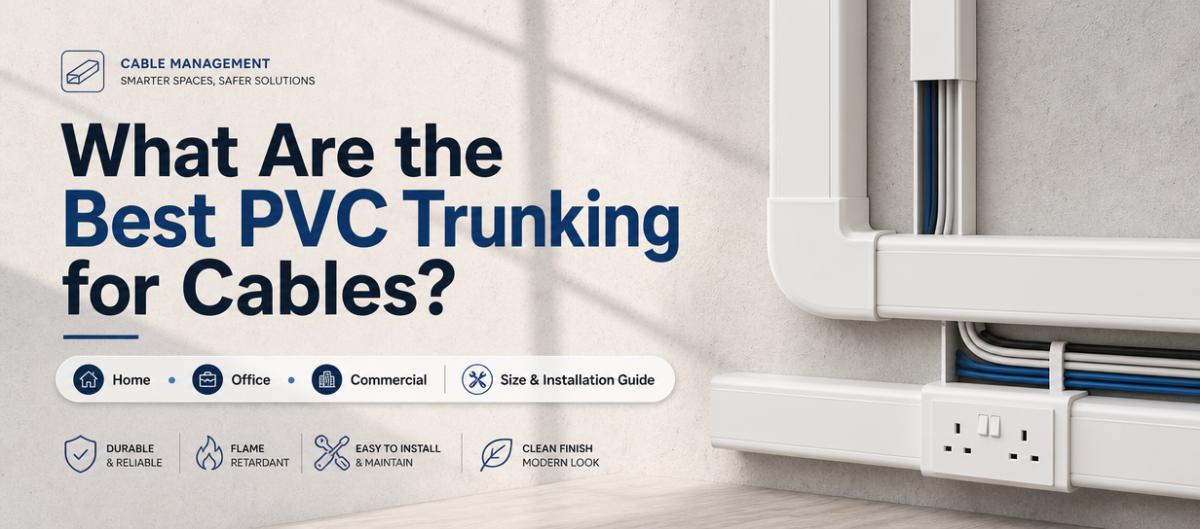
Messy cables are more than an eyesore. They collect dust. They create trip risks. They make maintenance harder. In offices, they can even affect how professional a space feels. I have seen many cable runs fail because the wrong trunking was used from the start. Too small. Too weak. Too hard to open. The good news is simple. The right PVC trunking can protect cables, improve safety, and keep any space clean.
The best PVC trunking for cables depends on where you use it. For homes, I recommend sleek and paintable trunking like D-Line or Tinyhomie. For offices, I prefer higher-capacity raceways such as ANTON or Lukyamzn. For commercial and industrial runs, I choose stronger systems like RS PRO, Marshall Tufflex Maxi Trunking, or ANTON. The best option should offer enough capacity, strong PVC material, easy access, and a clean finish.
I’m Jason. I work with PVC trunking and cable management, so I always look at the same things first: size, durability, safety, access, and appearance.
Quick Answer: Best PVC Trunking by Application
Here is my simple breakdown.
| Application | Best PVC Trunking Type | Recommended Brands | Why I Recommend It |
| Home TV walls and entertainment centers | Mini PVC cable trunking | D-Line, Tinyhomie | Sleek, paintable, and easy to hide |
| Home office and desk cables | Medium PVC raceway | ANTON, Lukyamzn | Better cable capacity and easier access |
| Open office floors and under-desk runs | High-capacity cable trunking | ANTON, Lukyamzn | Good for multiple power and data cables |
| Commercial walls and service routes | Solid PVC trunking | RS PRO, Marshall Tufflex | Stronger build and professional finish |
| Industrial cable runs | Maxi trunking or slotted trunking | Marshall Tufflex Maxi Trunking, RS PRO, ANTON | Durable, accessible, and suitable for larger cable bundles |
What Is PVC Trunking?
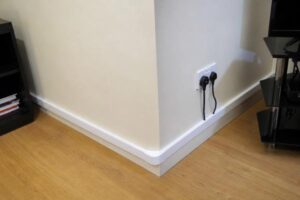
PVC trunking is a plastic cable management channel used to route, cover, and protect cables.
It usually has two parts.
- A base fixed to the wall, floor, desk, or panel.
- A removable cover that snaps or slides into place.
I use PVC trunking because it is light, affordable, and easy to cut. It also looks cleaner than loose cables.
You will see it in homes, offices, shops, workshops, warehouses, and control panels.
For general cable raceway examples, I often refer people to cable management suppliers like CableOrganizer, because it gives a good view of common raceway styles.
Why Is PVC Trunking Important for Cable Management?
The main job of PVC trunking is simple.
It protects cables and keeps them organized.
But in real projects, it does more than that.
Good PVC trunking helps:
- Reduce exposed wiring
- Improve room appearance
- Lower trip hazards
- Make cable inspection easier
- Support future cable changes
- Separate low-voltage and power cables when needed
Cable clutter can increase slip and trip risk in workplaces. Safety organizations such as the UK Health and Safety Executive explain that good housekeeping helps reduce slip and trip accidents: HSE slips and trips guidance.
That is why I do not see trunking as “just decoration.”
I see it as part of a safe cable layout.
What Should I Check Before Buying PVC Trunking?
Before I recommend any PVC trunking, I check six key points.
| Buying Factor | What I Check | Why It Matters |
|---|---|---|
| Size and capacity | Cable count, cable diameter, future expansion | Prevents overcrowding and hard maintenance |
| Material strength | Wall thickness and cover grip | Reduces cracking and loose covers |
| Fire performance | Product ratings and manufacturer data | Important for homes, offices, and commercial projects |
| Access style | Snap-on cover, open-slot, or solid cover | Affects future cable changes |
| Appearance | Color, profile, paintability | Helps trunking blend into the room |
| Installation method | Adhesive, screws, clips, corner fittings | Impacts speed and long-term hold |
I always leave extra room inside the trunking.
My practical rule is simple:
Choose trunking with at least 20% spare capacity.
That extra space helps when you add one more HDMI cable, network cable, speaker wire, or power lead later.
PVC Trunking Size Guide
Choosing the right size is where many people make mistakes.
If the trunking is too small, cables get squeezed.
If it is too large, it looks bulky.
Here is a practical guide I use.
| Trunking Size Category | Typical Use | Best For | My Advice |
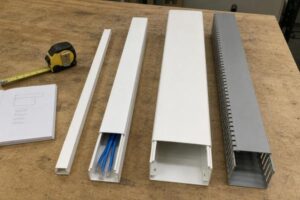
| Small / Mini trunking | 1–3 light cables | TV cable, speaker wire, internet cable | Best for visible home areas |
| Medium trunking | 3–8 cables | Home office, gaming setup, desk cables | Good balance of size and capacity |
| Large trunking | 8+ cables | Office walls, meeting rooms, workstation rows | Choose removable covers for easy access |
| Maxi trunking | Heavy cable bundles | Commercial and industrial routes | Use for long runs and future expansion |
| Slotted trunking | Control panels and machinery | Industrial cable separation | Best where cables need frequent changes |
My rule is simple.
If you think you need one size, consider the next size up.
That small extra space can save a lot of trouble later.

Best PVC Trunking for Home and Entertainment Centers
For home use, I care about two things.
Clean appearance and easy installation.
Most homeowners do not want industrial-looking trunking on the wall.
That is why I like these options.
D-Line PVC Cable Trunking
D-Line is one of my favorite choices for living rooms, TV walls, and entertainment centers.
Its trunking often has a rounded profile.
That makes it look softer than square industrial trunking.
It can also be painted in many setups.
I recommend D-Line when the trunking will be visible.
Best for:
- Wall-mounted TVs
- Router cables
- Speaker cables
- Gaming setups
- Small home office runs
My expert note: If appearance is your top priority, D-Line is one of the safest choices.
Tinyhomie Cable Trunking
Tinyhomie cable trunking is another option for home cable management.
It is usually used for smaller cable routes.
I see it as a practical choice for renters, bedrooms, and simple home setups.
Best for:
- Short cable runs
- Desk areas
- TV units
- Light-duty cable hiding
My expert note: Tinyhomie is best when you need a simple and affordable home solution.
Best PVC Trunking for Office and Under-Desk Management
Office cable management is different.
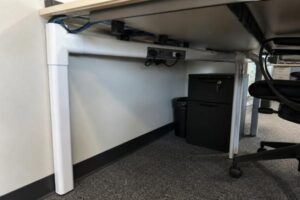
You may need to manage power cords, monitor cables, Ethernet cables, chargers, and docking station leads.
So I care more about capacity and access.
ANTON Cable Trunking
ANTON cable trunking is a strong option for office and under-desk cable routing.
I like it when the cable bundle is larger.
It suits workstations, shared desks, and computer areas.
Best for:
- Under-desk cable management
- Multi-monitor setups
- Office workstations
- Power and data cable grouping
My expert note: ANTON is a good pick when you need more cable room than basic mini trunking can offer.
Lukyamzn 5-PCS Electrical Cable Management Raceway
The Lukyamzn cable management raceway is useful for under-desk and wall-mounted office cable runs.
The 5-piece format can be helpful for small projects.
You can cut and arrange sections as needed.
Best for:
- Desk cable cleanup
- Office corners
- Charging stations
- Small meeting rooms
My expert note: I recommend Lukyamzn when you want a simple kit-style solution for office cables.
Best PVC Trunking for Commercial and Industrial Runs
Commercial and industrial projects need a different mindset.
Looks still matter.
But durability, size, and long-term access matter more.
RS PRO PVC Cable Trunking
RS PRO PVC cable trunking is a professional option.
I consider it suitable for commercial buildings, service areas, and technical installations.
RS PRO products are often used by electricians and maintenance teams.
Best for:
- Commercial cable routes
- Utility rooms
- Workshops
- Electrical service areas
My expert note: RS PRO is a reliable choice when you want a professional-grade PVC trunking system.
Marshall Tufflex Maxi Trunking
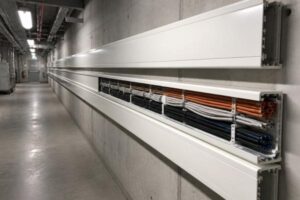
Marshall Tufflex Maxi Trunking is one of the names I trust for larger cable management projects.
It is widely used in commercial environments.
The maxi trunking format gives more internal space.
That is useful for future cable upgrades.
Best for:
- Schools
- Offices
- Hospitals
- Retail buildings
- Commercial corridors
My expert note: If you need high-capacity trunking with a professional finish, Marshall Tufflex is one of the best brands to consider.
ANTON Cable Trunking for Heavy-Duty Layouts
ANTON can also work in larger cable routes, depending on the model.
I would use it for workshops, garage areas, and office-to-commercial crossover projects.
Best for:
- Workbenches
- Utility rooms
- Larger desk systems
- Small commercial runs
My expert note: Always check the dimensions before buying. Industrial cable bundles need enough internal room.
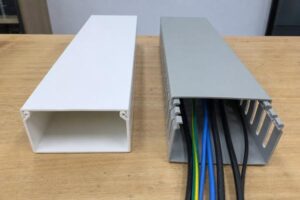
Solid PVC Trunking vs Slotted PVC Trunking
This is a common question.
Both are useful.
But they are not the same.
Solid PVC Trunking
Solid PVC trunking has closed sides.
It gives a clean appearance.
I use it more in homes, offices, corridors, and visible wall runs.
Best for:
- General cable hiding
- Wall-mounted cable routes
- Neat commercial installations
- Home cable concealment
Slotted PVC Trunking
Slotted PVC trunking has side openings.
These slots allow cables to enter and exit at different points.
I use slotted trunking more in control panels, machinery, and technical cabinets.
Best for:
- Electrical panels
- Industrial wiring
- Frequent cable changes
- Cable separation inside enclosures
My recommendation: Use solid trunking for visible spaces. Use slotted trunking for technical wiring.
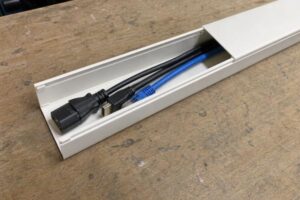
How Do I Choose the Best PVC Trunking?
Here is my step-by-step method.
Step 1: Count Your Cables
Count every cable.
Include future cables if possible.
Do not forget adapters, chargers, HDMI leads, Ethernet cables, and power cords.
Step 2: Measure Cable Thickness
Some cables are much thicker than others.
Power cords and HDMI cables need more space than thin signal wires.
Step 3: Choose the Route
Decide if the trunking will run along:
- A wall
- A skirting board
- A desk
- A floor
- A ceiling
- A cabinet
The route affects the style you need.
Step 4: Pick the Right Cover Style
For maintenance areas, choose a cover that opens easily.
For visible home areas, choose a cover that looks smooth.
Step 5: Check Installation Surface
Adhesive can work on clean, smooth surfaces.
But I prefer screws for stronger installation.
Especially for long runs.
Especially for heavier cable bundles.
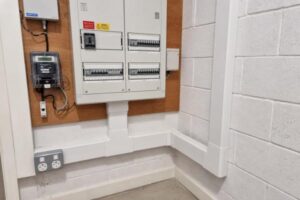
Is Fire Resistance Important for PVC Trunking?
Yes.
Fire performance is important, especially in offices, commercial buildings, and industrial spaces.
PVC itself has properties that make it widely used in electrical applications, but not every trunking product performs the same.
That is why I always check:
- Manufacturer specifications
- Fire rating claims
- Compliance information
- Intended installation environment
- Local electrical codes
For home cable hiding, you still want a quality product.
For commercial work, fire performance becomes even more important.
I never assume.
I verify.
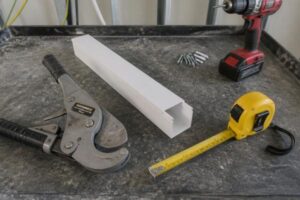
How Do I Install PVC Trunking Properly?
I keep installation simple.
Here is my usual process.
- Plan the cable route
- Measure the run
- Choose the correct trunking size
- Cut the PVC cleanly
- Fix the base with screws or adhesive
- Place cables without forcing them
- Clip on the cover
- Check corners and joints
- Leave access where future changes may happen
For light home use, adhesive backing may be enough.
For commercial or long-term work, I prefer screws.
Adhesive can fail over time, especially on dusty, painted, damp, or uneven surfaces.
If I am installing trunking in a high-traffic area, I use mechanical fixing.
That is more reliable.

When Should I Not Use Basic PVC Trunking?
PVC trunking is versatile.
But it is not always the answer.
I avoid basic PVC trunking in these cases:
- Very high heat areas
- Heavy impact zones
- Outdoor UV-heavy locations unless rated
- Wet areas without suitable protection
- Locations needing metal containment
- Fire-critical installations requiring special systems
In these situations, I look at rated outdoor trunking, metal trunking, conduit, or other approved containment systems.
The key point is simple.
Use the trunking for the environment it was designed for.
More Related Questions
Is PVC Trunking Safe for Electrical Cables?
Yes. PVC trunking is commonly used for cable protection and cable organization. But you must choose the right size and follow local electrical rules.
For power wiring, I recommend professional installation.
Can I Paint PVC Trunking?
Yes.
Many PVC trunking products can be painted.
I always clean the surface first.
Then I use a suitable primer and paint.
This works well for home interiors.
Is Adhesive-Backed Trunking Strong Enough?
Sometimes.
It works for small, light cable runs.
But for heavy cable bundles, I prefer screws.
Adhesive can weaken over time.
Heat, dust, and wall texture can affect it.
What Is the Best PVC Trunking for a TV Wall?
I recommend D-Line PVC cable trunking for TV walls.
It has a cleaner look than square trunking.
It also blends better with home interiors.
What Is the Best PVC Trunking for Offices?
For offices, I recommend ANTON cable trunking or Lukyamzn cable management raceway.
They work well for under-desk cables, monitors, chargers, and network cables.
What Is the Best PVC Trunking for Industrial Use?
For industrial or commercial runs, I recommend RS PRO PVC cable trunking, Marshall Tufflex Maxi Trunking, or ANTON, depending on the cable load.
Conclusion
The best PVC trunking depends on your space. Use D-Line or Tinyhomie for homes, ANTON or Lukyamzn for offices, and RS PRO or Marshall Tufflex for commercial runs. My advice is simple: choose enough capacity, strong PVC, easy access, and a clean finish.