What Are the Standard Sizes for PVC Electrical Trunking?
- Written by
- Jason
- Published
- Reading time
- 10 min read
Choosing the wrong PVC electrical trunking size can turn a clean wiring job into a frustrating one. I have seen this happen many times. The trunking looks fine at first. Then the cables become too tight. The cover does not close properly. Future maintenance becomes painful.
Worse, overcrowded cable containment can affect heat dissipation and make inspection harder.
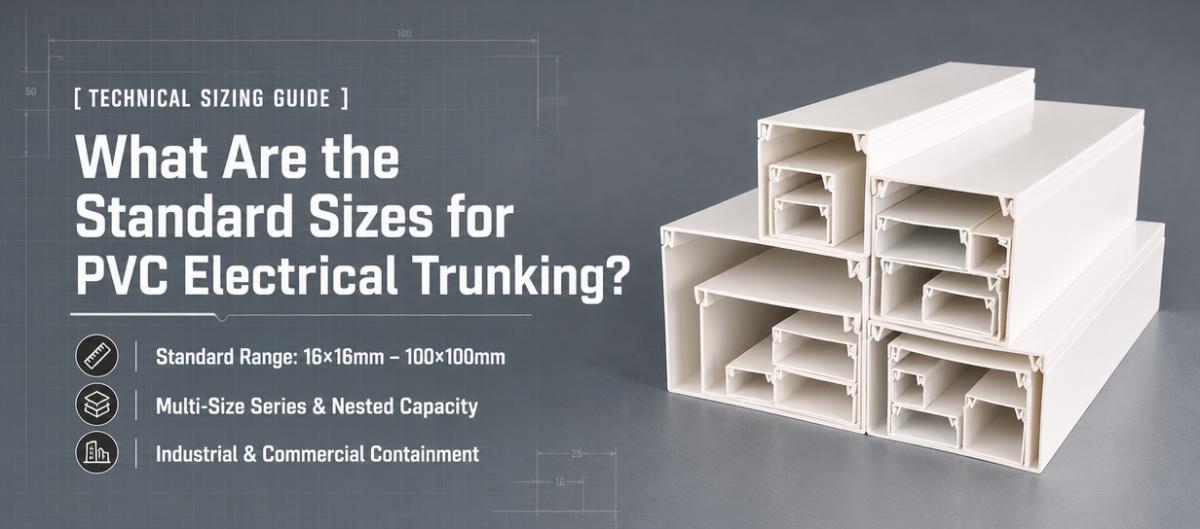
The standard sizes for PVC electrical trunking usually range from small sizes like 16mm × 16mm and 25mm × 16mm to larger sizes such as 50mm × 50mm, 75mm × 75mm, and 100mm × 100mm. These are common market sizes used in homes, offices, shops, schools, and light commercial projects.
The right size depends on cable quantity, cable diameter, installation location, and future wiring needs.
If you are planning a wiring project, I recommend that you do not choose trunking by eye. A better method is to count the cables, check their outside diameter, allow spare space, and then match the bundle to a suitable trunking size.
Quick Answer: What PVC Electrical Trunking Sizes Are Standard?
In my experience, the most common PVC electrical trunking sizes include:
- 16mm × 16mm
- 25mm × 16mm
- 25mm × 25mm
- 38mm × 25mm
- 40mm × 25mm
- 40mm × 40mm
- 50mm × 50mm
- 75mm × 50mm
- 75mm × 75mm
- 100mm × 50mm
- 100mm × 100mm
These dimensions normally refer to the external width and height of the trunking.
But here is the important point.
There is no single global “one-size list” for PVC electrical trunking. Sizes can vary by country, manufacturer, product range, and wiring standard. For example, a supplier may offer 25mm × 16mm, while another may offer 25mm × 20mm.
Common PVC Electrical Trunking Sizes and Typical Uses
The table below gives a practical guide. I use this kind of thinking when helping customers choose trunking for real projects.
| PVC Trunking Size | Typical Use | Common Project Type |
|---|---|---|
| 16mm × 16mm | One or two small cables | Small domestic wiring, surface cable protection |
| 25mm × 16mm | Light cable runs | Homes, small offices, lighting circuits |
| 25mm × 25mm | Several small cables | Residential rooms, retail counters |
| 38mm × 25mm / 40mm × 25mm | Mixed low-voltage or power cables | Offices, schools, workshops |
| 40mm × 40mm | Medium cable capacity | Commercial wiring, control wiring |
| 50mm × 50mm | Heavier cable grouping | Shops, office renovations, light industrial work |
| 75mm × 50mm | Larger cable bundles | Commercial distribution areas |
| 75mm × 75mm | High-capacity runs | Plant rooms, larger service areas |
| 100mm × 50mm | Wide cable routes | Main cable runs, commercial corridors |
| 100mm × 100mm | Very large cable capacity | Industrial and large commercial installations |
My rule is simple: never fill trunking so tightly that the cables are forced into place. A good installation should be neat, serviceable, and ready for future work.

Why Does PVC Trunking Size Matter?
PVC trunking is not just a plastic cover.
It improves appearance.
It makes maintenance easier.
It also helps keep wiring organized.
When the size is wrong, the whole system suffers.
If the trunking is too small:
- Cables become cramped
- The cover may not close securely
- Heat may build up more easily
- Future cable replacement becomes difficult
- The installation looks poor
If the trunking is too large:
- Material cost increases
- Wall or ceiling space is wasted
- The installation may look bulky
- It may be harder to fit around corners or tight areas
That is why I always tell people this: choose trunking size based on cable capacity, not just appearance.
For safety and wiring rules, I recommend referring to recognized electrical standards and guidance, such as IET BS 7671 Wiring Regulations in the UK or NFPA 70 National Electrical Code in the United States.

How Do I Choose the Right PVC Trunking Size?
I use a simple step-by-step method.
1. Count the cables
Start with the number of cables you need to install.
Do not guess.
Count every cable.
Include power cables, data cables, alarm cables, control cables, or low-voltage wires if they share the route.
2. Check the cable outside diameter
Cable size is not only about conductor size.
The outside diameter matters because that is what physically fills the trunking.
For example, two cables with the same conductor size may have different insulation thicknesses.
3. Consider cable type
Different cable types need different space.
Power cables, network cables, coaxial cables, and control wires behave differently.
Some are flexible.
Some are stiff.
Some need more bending space.
4. Allow spare capacity
This is one of my strongest recommendations.
Do not fill the trunking completely.
Leave spare room for:
- Future upgrades
- Easier maintenance
- Better cable organization
- Easier cover fitting
5. Check local rules
Every region may have different requirements.
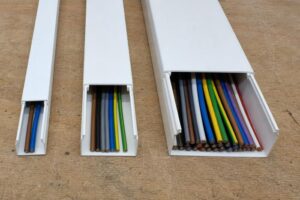
Suggested PVC Trunking Size by Cable Load
This table is a general planning guide. It is not a replacement for local electrical regulations, but it gives a useful starting point.
| Cable Load Level | Example Cable Quantity | Suggested PVC Trunking Size | My Practical Advice |
|---|---|---|---|
| Very light load | 1–2 small cables | 16mm × 16mm | Good for short, simple surface runs |
| Light load | 2–4 small cables | 25mm × 16mm or 25mm × 25mm | Common for home and small office use |
| Medium load | 4–8 small/medium cables | 40mm × 25mm or 40mm × 40mm | Better for mixed wiring routes |
| Heavy load | 8–15 cables | 50mm × 50mm or 75mm × 50mm | Good for commercial installations |
| Very heavy load | 15+ cables | 75mm × 75mm or 100mm × 100mm | Use for main routes and larger projects |
Again, this is a guide.
The real answer depends on cable diameter, bending radius, derating requirements, and installation conditions.

What Are the Most Common PVC Trunking Sizes for Homes?
For homes, I usually see smaller trunking sizes.
The most common are:
- 16mm × 16mm
- 25mm × 16mm
- 25mm × 25mm
- 38mm × 25mm
- 40mm × 25mm
These sizes are popular because residential cable runs are usually lighter.
They are used for:
- Lighting circuits
- Small power extensions
- Internet cable routes
- TV cable routes
- Low-voltage wiring
- Surface-mounted cable protection
If the installation is visible, appearance also matters.
A smaller trunking size usually looks cleaner on walls.
But I still avoid choosing the smallest option if more cables may be added later.
A slightly larger trunking can save future labor.
What Are the Most Common PVC Trunking Sizes for Offices and Shops?
For offices and retail spaces, I often recommend medium sizes.
Common choices include:
- 40mm × 40mm
- 50mm × 50mm
- 75mm × 50mm
- 75mm × 75mm
- 100mm × 50mm
Commercial spaces need more cable capacity.
They often include:
- Power cables
- Data cables
- Security system cables
- Fire alarm cables
- CCTV cables
- Access control cables
The installation also needs to be easier to inspect and modify.
That is why commercial trunking should allow more spare capacity than a simple home installation.
For general cable management product references, you can also review supplier categories such as CEF cable management or ANTON Cable Management.
What Is the Difference Between Mini Trunking and Standard PVC Trunking?
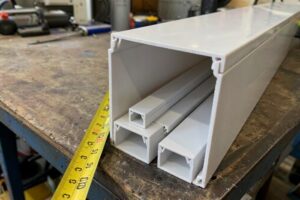
Mini trunking is usually smaller and used for light-duty surface wiring.
Standard PVC trunking is larger and used for higher cable capacity.
Mini trunking
Mini trunking often includes sizes like:
- 16mm × 16mm
- 25mm × 16mm
- 25mm × 25mm
It is common in homes, small offices, and light cable routes.
Standard or larger trunking
Larger PVC trunking includes:
- 40mm × 40mm
- 50mm × 50mm
- 75mm × 75mm
- 100mm × 100mm
It is used where more cables need to be grouped and protected.
If I only need to hide one or two small cables, mini trunking is usually enough. If I need a main route, I move up to larger PVC trunking.
Should I Use 25mm or 50mm PVC Trunking?
This is a common question.
My answer depends on the cable load.
Use 25mm PVC trunking when:
- The cable run is light
- You only have a few cables
- The installation is residential
- Appearance is a priority
- Future expansion is limited
Use 50mm PVC trunking when:
- You have many cables
- The cables are thicker
- The route is commercial
- You expect future wiring changes
- You need easier access for maintenance
If you are unsure between two sizes, I usually recommend choosing the larger one, as long as it still fits the space and looks acceptable.
Can PVC Electrical Trunking Be Customized?
Yes, PVC electrical trunking can sometimes be customized.
But it depends on the manufacturer and order quantity.
Custom options may include:
- Special width
- Special height
- Different color
- Different cover type
- Flame-retardant material
- UV-resistant PVC
- Pre-punched base
- Special accessories
However, standard trunking sizes are usually faster and cheaper.
Custom trunking is useful for:
- Large construction projects
- Industrial installations
- OEM electrical systems
- Special architectural designs
- Projects with strict color matching
For most normal projects, I suggest using standard sizes because they are easier to source and easier to replace.
What Mistakes Should I Avoid When Choosing PVC Trunking?
I have seen the same mistakes again and again.
Here are the big ones.
Mistake 1: Choosing only by price
Cheap trunking may look attractive.
But poor-quality PVC can crack, discolor, or deform.
Mistake 2: Ignoring cable capacity
This is the most common problem.
If the trunking is too small, the job becomes difficult and unsafe.
Mistake 3: Forgetting future expansion
Many installations change over time.
New data cables.
New cameras.
New sockets.
New control wiring.
Leave space.
Mistake 4: Mixing cables without checking rules
Power and data cables may need separation.
Fire alarm cables may have special requirements.
Always check local electrical standards.
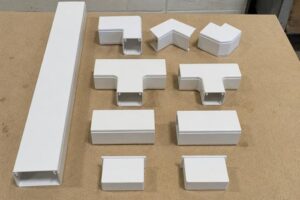
Mistake 5: Forgetting accessories
Trunking is not only straight lengths.
You may also need:
- Internal angles
- External angles
- Flat bends
- Tees
- Couplers
- End caps
- Adaptable boxes
A good trunking system should include both the right size and the right accessories.
PVC Electrical Trunking Size Selection Checklist
Before I choose a PVC trunking size, I ask these questions:
- How many cables will go inside?
- What is the outside diameter of each cable?
- Is this a home, office, shop, or industrial site?
- Will more cables be added later?
- Does the installation need to look discreet?
- Are power and data cables separated correctly?
- Does the trunking need to meet local electrical standards?
- Are all bends, tees, and end caps available in the same size?
If the answer is unclear, I do not rush.
I measure again.
Then I choose.
More Related Questions
What Is the Smallest PVC Trunking Size?
The smallest common PVC trunking size is usually 16mm × 16mm. It is suitable for very light cable runs.
What Is the Most Popular PVC Trunking Size?
For residential and small office work, 25mm × 16mm and 25mm × 25mm are very popular. For commercial work, 50mm × 50mm is common.
Is 100mm × 100mm PVC Trunking Standard?
Yes, 100mm × 100mm is a common large PVC trunking size. It is often used for heavier cable runs in commercial or industrial projects.
Are PVC Trunking Sizes Measured Internally or Externally?
Most listed trunking sizes refer to external dimensions. Internal space may be smaller because of wall thickness and cover design.
Can I Put Too Many Cables in PVC Trunking?
Yes. Overfilling trunking is a bad practice. It can make installation difficult, reduce serviceability, and create heat management concerns.
Conclusion
Standard PVC electrical trunking sizes usually range from 16mm × 16mm to 100mm × 100mm. I choose the size based on cable quantity, cable diameter, spare capacity, and local wiring rules. When in doubt, I prefer a slightly larger trunking size for safer, cleaner, and more flexible installation.